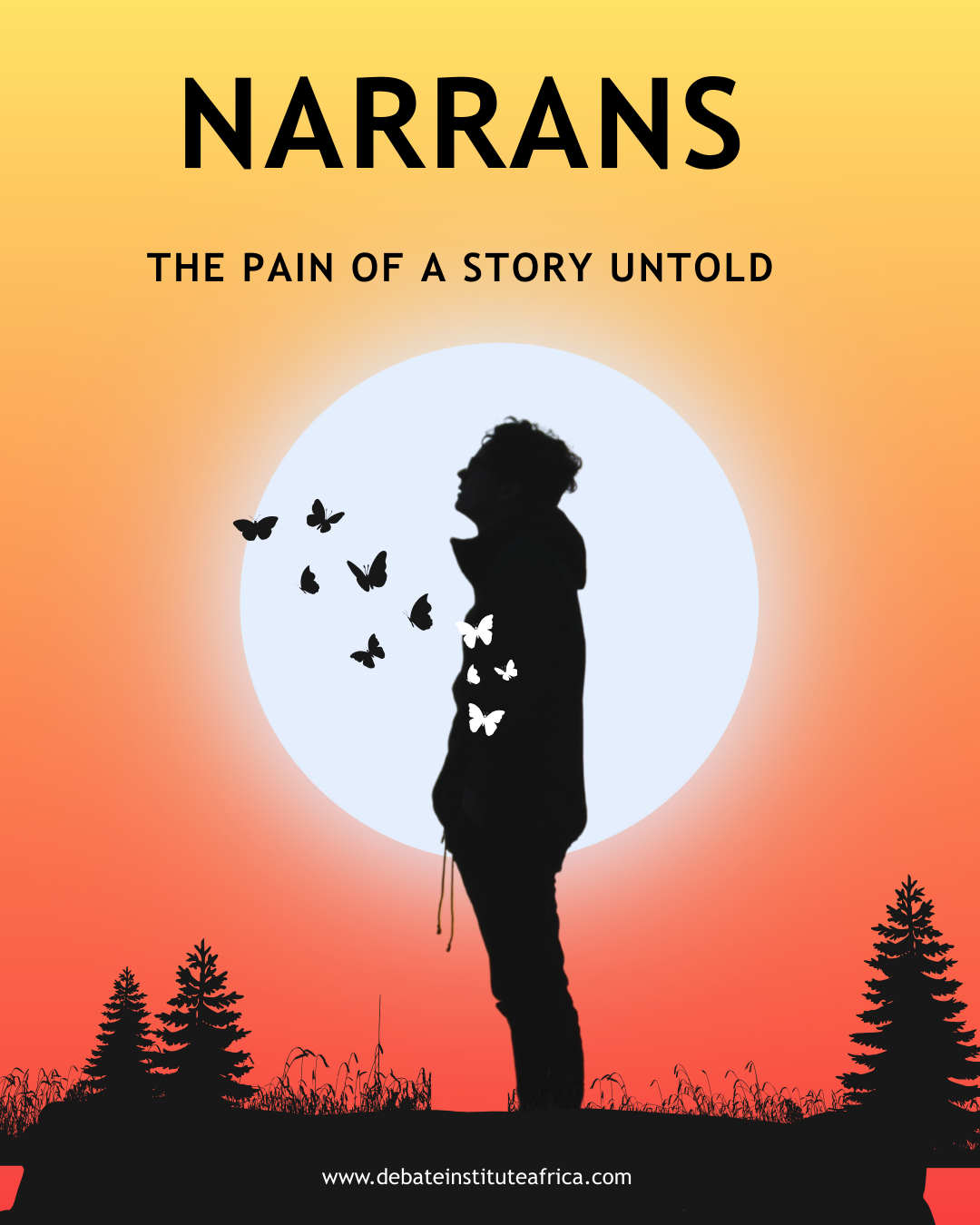
There is a peculiar ache that lingers in the soul of humankind: the pain of the untold story. It is not the pain of a broken bone, which can be set and bound, nor of a wound, which in time may scar and heal. It is subtler, yet heavier. The unspoken tale presses upon the chest like a stone, invisible but suffocating, whispering in the night: Tell me, or I shall never let you rest. We carry within us entire libraries of experience, yet too often we walk the earth like silent mausoleums, unvisited, unvoiced, unremembered. Why should a story, even unuttered, weigh upon us so grievously? Why does silence burn more bitterly than speech?
Storytelling is humanity’s oldest library. Through oral tradition, wisdom traveled across generations long before books or screens existed. Most human knowledge is tacit — carried in memory, ritual, and speech — not in written code. A proverb, a myth, a folktale: these were survival manuals and moral compasses disguised as stories. To be homo narrans is to live by this truth — that we remember not by storing data but by weaving meaning. When stories die, knowledge withers; when they are told, they become bridges through which cultures endure.
The ancients perhaps knew. Aristotle named man zoon logon echon — not merely the rational animal, but the creature who bears speech. To be human is to be haunted by the compulsion to narrate, to arrange the chaos of life into beginning, middle, and end. Without this act of telling, the chaos remains chaos, and the soul languishes amidst its own confusion. Stories shape human experiences into lessons that we then carry forward. Without this act of telling, experience lies scattered, a heap of unjoined fragments. Yet when we give it form, the fragments become a path. Every life, whether humble or heroic, falls into this rhythm: the innocent beginning, the middle of struggle and conflict, the end that gathers meaning. In story we find growth, beauty, and wisdom. Without story, we are lost in confusion; with it, we become authors of our own humanity.Thus storytelling is not ornament, not pastime, but necessity.
There is no sharper wound in the human conscience than the suffering that cannot find a voice. To live with a story untold is already to ache. But when that silence cloaks the lives of millions of children, the ache becomes unbearable, a collective betrayal of humanity itself.
Bill Gates, in his Harvard commencement address, confessed that he left the university brilliant in ideas but blind to inequity. He knew algorithms, politics, economics—but not the simplest, starkest truth: that millions of children die each year from preventable diseases, diseases the rich world no longer fears. Measles, malaria, pneumonia, rotavirus—names that haunt the graveyards of the poor. These children did not fail for lack of courage or dignity; they died because their parents had “no power in the market and no voice in the system.” Their stories were smothered by silence.
Here lies the most grievous pain of a story untold: it is not simply forgotten—it is forbidden. Power dynamics decide whose cries echo and whose vanish into the dust. A child in Boston struck by fever will appear on a news cycle; a thousand children in Burkina Faso struck by the same fever will never appear at all. Markets do not hear them. Governments rarely hear them. And so their stories dissolve before they are ever spoken.
This is why storytelling is no longer an indulgence; it is an obligation. The best of us—the educated, the privileged, the fortunate—must lend our words to those whose lips are sealed by circumstance. To tell their stories is to carve space in a world that would rather look away. Statistics can shock but rarely stir; a percentage point cannot weep. But a child with a name, a face, a laugh interrupted by illness—such a story pierces indifference.
The world, Gates observed, is paralyzed not by cruelty but by complexity. People care, but they do not know how to act. Stories cut through that fog. They make suffering visible, they make injustice personal, they translate the abstract into the immediate. They create not only sympathy, but urgency. They force us to see the unbearable truth: every child lost to preventable disease is a chapter torn from the book of humanity, never to be read, never to be learned from. Bill Gates urged Harvard graduates to confront “the world’s deepest inequities.” Yet inequity remains unseen until it is told. Storytelling transforms statistics into faces, silence into conscience. To commit our privilege to justice, we must not only solve problems, but speak them—turning hidden suffering into shared human urgency.
And so the call is clear. If the children cannot speak for themselves, then we must become their storytellers. We must refuse to let their silence be final. We must make their hidden narratives not only heard but heeded—woven into the conscience of our age. For only then can the stories of tomorrow be less tragic, less unfinished, less buried in grief.
Anthropologists call us homo narrans — the storytelling species. Fire, wheel, plough: none would have endured had we not sat in caves and whispered into flames the story of how to use them. Philosophy itself admits its dependence upon narrative. Paul Ricoeur reminds us that we know ourselves only through the stories we tell. Psychology agrees: trauma, left untold, festers; spoken, it may heal. Donald Davis recalled his father, “Cripple Joe,” crippled by a childhood accident, whose wise mother forced him to repeat the tale again and again, each time from a new vantage — what he learned, what his parents learned, what even the doctors learned. In time the accident ceased to be a crushing rock upon him and became a seat beneath him. The story did not change the event, but it changed the boy. Religion and myth, too, are stories sanctified. Genesis begins not with theorem but with tale: “In the beginning…” Civilizations crumble when their stories fade.
But what of stories never told? Here lies the true agony. Personal silence isolates. Matthew Dicks, the reluctant teacher forced onto a stage at the Moth in Manhattan, discovered that unshared stories breed misery. Yet when he dared narrate his own vulnerability, strangers pressed upon him with confessions of miscarriages, thefts, secret compulsions — all because his story gave them permission to speak. Historical silence erases. Millions vanish from the record when their stories are unvoiced. Elie Wiesel warned, “To remain silent is to betray.” Political silence enslaves. Dictators fear not arguments but testimonies, for a mother’s story of hunger can topple a regime more swiftly than a hundred statistics. Silence itself is a cruel rhetoric: an unsaid that gnaws at the speaker and starves the listener.
Stories matter because they wield power no abstract can match. They persuade: a sign reading “I am blind” gathers pennies, but rewritten as “It is a beautiful day, and I cannot see it,” it gathers coins by the handful. They deliver justice: courtrooms are theatres of testimony. They build community: around campfires or glowing screens, people lean in together. Even Zach King’s “Jedi Kittens,” filmed with cardboard and spray paint, gathered millions to a virtual hearth, proving that the medium may shift but the communal function endures. And stories resist oppression: to tell one’s truth against power is rebellion itself.
Yet story is both sword and salve. As weapon, it can rouse nations, incite revolutions, or deceive multitudes. Propaganda is simply story bent to sinister ends. As balm, story heals wounds and reconciles enemies. When Matthew Dicks shared his homelessness, he transformed shame into chapter, and a ten-year-old girl, living in a car, dared whisper her plight. Story saved her. A tale may enslave, as Chimamanda Adichie warns of the danger of a single story, but many tales may set a people free.
To tell a story, then, is never innocent. Every tale carries ethical freight. Who speaks, who listens, who is silenced — these are not idle questions. The ethos of the storyteller rests not upon flourish but upon fidelity to truth. Even fiction must serve a deeper truth, lest it decay into falsehood. Donald Davis’s grandmother understood this when she told her boy, “You are not telling the story to change what happened, but to change you.” The corporate storyteller likewise warns that false tales have the shelf life of milk. The public forgives embellishment, but not betrayal.
Stories never end. They echo, reshape, inspire new stories. The caveman’s mastodon hunt becomes Greek myth, becomes Shakespearean drama, becomes silent film, becomes six-second video. The form alters, the essence endures. Untold stories, meanwhile, haunt. They drift as ghosts, demanding voice. If we will not give them tongue, they will trouble our sleep. Better to speak them, however haltingly, than to bear their phantom weight forever.
And so we return to the ache with which we began: the pain of the untold story. Silence may feel safe, but it corrodes. Speech may feel perilous, but it liberates. Tell your story, however small. Listen to the stories of others, however strange. Preserve the stories of those who came before, lest they vanish into dust. Aristotle called us speech-bearing animals; let us not betray that birthright. Adichie warns against the danger of a single story; let us multiply them. Wiesel declared that silence is betrayal; let us speak. For to tell is to live twice — once in experience, once in memory — and to be silent is to die before dying. Tell, then. Tell, lest the stone of the untold press you into the earth. Tell, for rhetoric demands it. Tell, for humanity requires it. Tell, because the pain of a story untold is heavier than any suffering that can be spoken.
That is why, at DIA, we believe storytelling must have a central place in oratory. It is not ornament but essence—the bridge between knowledge and meaning. And so we make it crucial to every educational program we curate, whether in Paragon Rhetorica, ISSDL, or beyond.